Your cart is empty
Looks like you haven't added anything to your cart yet


Why D3D Sigma PLA Has a Low Gloss Finish When Printing Fast — And Why That’s Great for Showpiece Prints
When customers walk into your showroom and compare prints side by side, one of the first things they notice is surface finish. Glossy vs matte. Shiny vs soft. Reflective vs premium.
If you’ve printed fast with D3D Sigma PLA, you may have noticed a more subtle, low-gloss finish — especially compared to high-sheen commodity PLA. This isn’t a flaw. It’s a feature.
Let’s break down why it happens and why it’s actually a huge advantage for display and showpiece prints.
Why D3D Sigma PLA Has a Low Gloss Finish at High Speeds
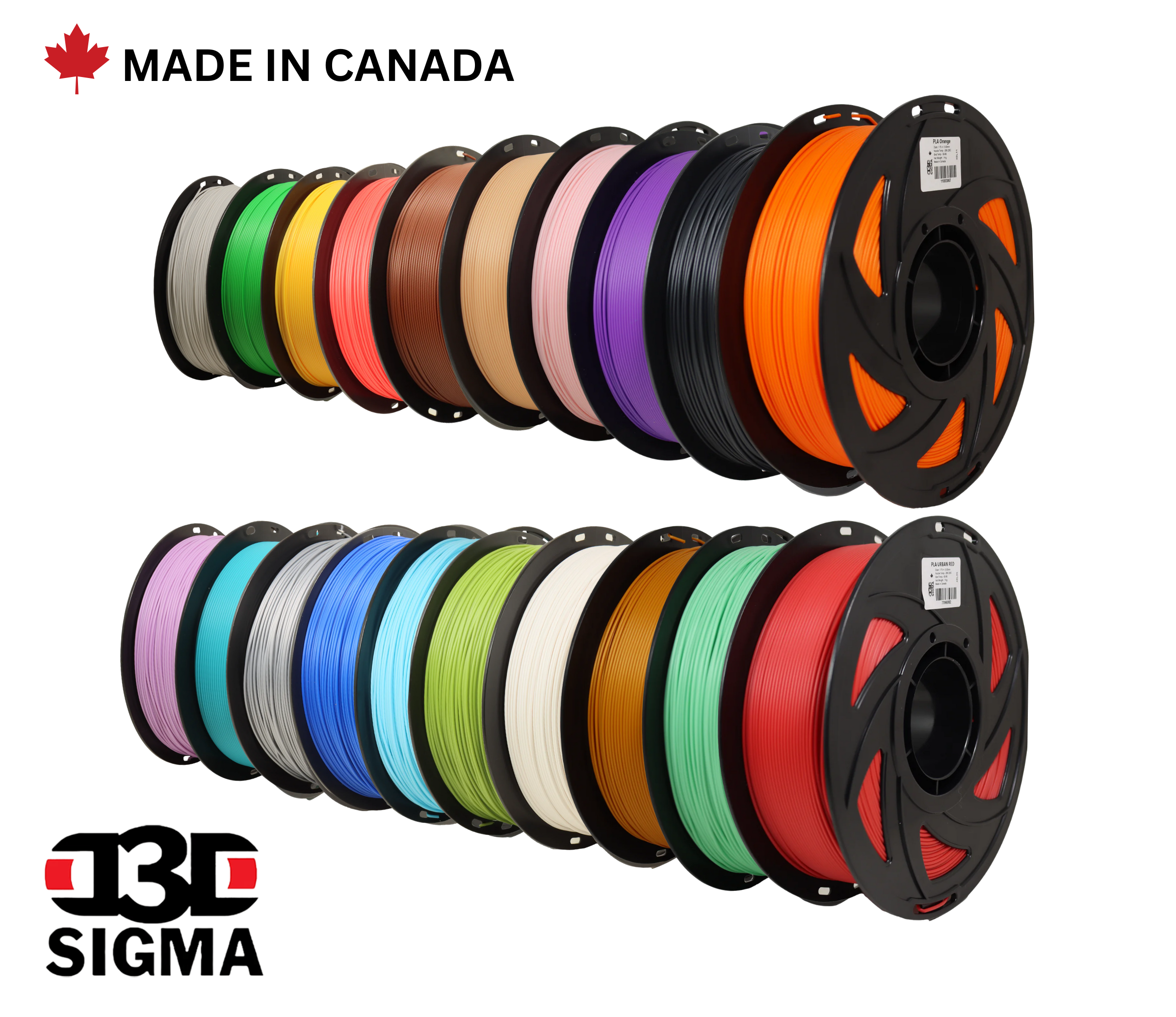
1️⃣ Fast Printing Reduces Surface Flow Time
When printing at high speeds (especially on machines like the Bambu Lab X1/P1 series), the filament has less time to “self-level” on the surface before cooling.
Glossy finishes usually happen when:
-
The polymer stays molten slightly longer
-
The surface tension allows it to smooth out
-
Light reflects evenly across a flatter micro-surface
At faster speeds, D3D Sigma solidifies quickly and locks in a consistent micro-texture — resulting in a refined satin or matte look instead of high gloss.
2️⃣ Optimized Crystallization from NatureWorks PLA Resin
D3D Sigma PLA is made using premium resin from NatureWorks LLC (Ingeo™ PLA).
NatureWorks PLA is known for:
-
Controlled molecular weight distribution
-
Consistent melt flow
-
Stable crystallization behavior
This consistency allows D3D Sigma to maintain excellent dimensional accuracy and surface uniformity, even at higher speeds. The controlled cooling behavior contributes to a smooth, soft-sheen surface instead of a plastic-like shine.
3️⃣ Non-Brittle, High-Accuracy Formula
D3D Sigma PLA is engineered with a non-brittle formula and tight tolerance control. When printing fast:
-
Layer lines stay crisp
-
Corners remain sharp
-
Details don’t “melt out”
-
The finish looks refined, not glossy-plastic
Instead of appearing like injection-molded toy plastic, your prints get a more premium, engineered look.
Why a Low Gloss Finish Is Actually Better for Showpiece Prints
✨ 1. Hides Layer Lines Better
Glossy surfaces reflect light harshly. This exaggerates:
-
Minor layer inconsistencies
-
Speed transitions
-
Seams
A satin or matte finish diffuses light, making prints appear smoother from all angles — especially under showroom lighting.
✨ 2. Looks More Premium
Most high-end consumer products today use matte or satin finishes because they look:
-
Modern
-
Professional
-
High-quality
-
Less “plasticky”
For display models, prototypes, figurines, and architectural prints, this makes a noticeable difference.
✨ 3. Better for Photography & Content Creation
If you create product photos or ASMR printing content (like many makers do), glossy prints often create harsh reflections.
Low-gloss prints:
-
Photograph better
-
Show details clearly
-
Require less lighting correction
-
Look more consistent on camera
✨ 4. Ideal for Fast Production Environments
If you're running high-speed production on printers like:
-
Bambu Lab X1 Carbon
-
Bambu Lab P1S
-
Bambu Lab P2S
D3D Sigma maintains:
-
Stable extrusion
-
Excellent layer bonding
-
Clean surface texture
-
Reduced visual defects
You get speed and aesthetics — without having to slow down just to improve surface shine.
Made in Canada. Powered by NatureWorks.
D3D Sigma PLA is:
-
🇨🇦 Made in Canada
-
🌱 Manufactured using NatureWorks Ingeo™ PLA resin
-
📏 High accuracy diameter control
-
💪 Non-brittle formula
-
🎨 Designed for consistent color and texture
Because it uses high-quality NatureWorks PLA and strict Canadian manufacturing standards, you get:
-
Reliable performance
-
Predictable results
-
Beautiful surface quality
-
Professional finish at high speed
When Should You Choose a Glossy Finish Instead?
Gloss can be beneficial when:
-
You want a toy-like or injection-molded look
-
You are printing decorative items that rely on shine
-
You’re printing very slowly at higher temperatures
But for most display pieces, prototypes, showroom models, and branded products — the soft, low-gloss finish of D3D Sigma gives a more refined and professional aesthetic.
Final Thoughts
Low gloss isn’t a compromise — it’s a performance characteristic.
When printing fast, D3D Sigma PLA delivers:
-
Dimensional accuracy
-
Clean layer definition
-
Subtle, premium surface texture
-
Excellent visual consistency
For makers who care about how their prints look — not just how fast they print — D3D Sigma offers the perfect balance of speed, strength, and aesthetics.
- Choosing a selection results in a full page refresh.