Your cart is empty
Looks like you haven't added anything to your cart yet


Bambu Lab H3C: What Makes This 9-Tool 3D Printer Different?
Multi-material 3D printing is becoming increasingly advanced, but changing between colours and materials has traditionally come with a few challenges: long changeover times, filament waste, and limitations when combining different materials in one print.
The Bambu Lab H3C takes a different approach.
Built around a nine-tool changing system called Swaptek, the H3C is designed to make multi-material printing faster and more versatile. Instead of repeatedly loading and unloading different filaments through one nozzle, it uses nine independent print tools, each with its own filament path and heating system.
Combined with FlexFeed technology and the integrated AMS 3H filament management system, the H3C opens up new possibilities for multi-colour printing, flexible materials, engineering filaments, and complex functional parts.
So, what makes the Bambu Lab H3C different from traditional 3D printers? Let's explore its most important features.
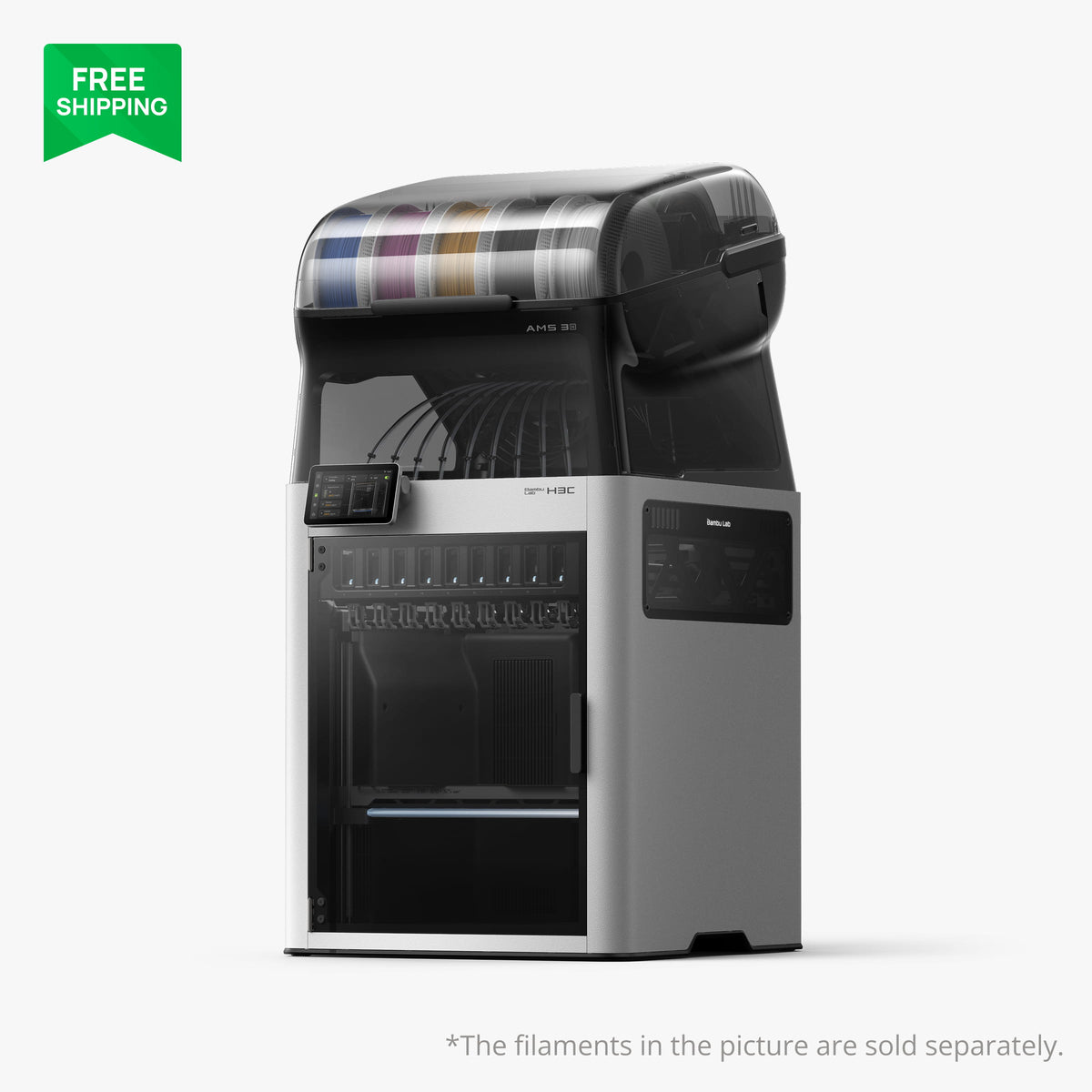
1. Nine Independent Print Tools with Swaptek Technology
The biggest innovation in the Bambu Lab H3C is its Swaptek nine-tool changing system.
Traditional multi-colour 3D printers typically use one printhead that switches between different filament supplies. Each time the printer changes materials, it must retract the current filament and feed the next one into the nozzle. This process can take time and generate waste as the previous material is purged.
The H3C approaches this differently.
It features nine independent print tools, each with its own filament path and heating system. This means the materials remain loaded and ready for use instead of having to pass through the same nozzle.
According to Bambu Lab, the Swaptek system can complete material changes in under six seconds.
Some of its key advantages include:
-
Faster material changes: Switch between dedicated print tools without repeatedly loading and unloading filament through one nozzle.
-
Reduced filament waste: Minimize the need for extensive purging during material transitions.
-
Multiple materials in one print: Combine different compatible materials for more complex designs.
-
Different nozzle sizes: Assign different nozzle diameters to different parts of a print.
-
More efficient multi-colour printing: Make complex colour combinations more practical.
The system also uses Active Pre-Heat technology, which begins heating the next print tool while the current tool is still working. This helps reduce waiting time during tool changes.
For anyone who regularly prints multi-colour models or multi-material components, this is one of the H3C's most interesting features.
2. FlexFeed: A New Approach to Flexible Filament Printing
Another standout feature is the H3C's FlexFeed extruder.
Flexible materials such as TPU can be challenging to print because softer filament tends to compress or bend during feeding. This can make consistent extrusion more difficult, particularly with very soft TPU formulations.
The H3C's FlexFeed system is designed to address this challenge.
It supports both 1.75 mm and 2.85 mm filament, allowing users to work with different filament formats. Its dedicated 2.85 mm feeding path provides additional support for softer flexible materials.
Bambu Lab states that the system can print TPU as soft as 75A, with flow rates up to three times those of conventional feeding solutions.
This opens up possibilities for applications such as:
-
Flexible footwear components
-
Protective cases and cushioning
-
Wearable accessories
-
Flexible hinges and connectors
-
Soft robotics components
-
Custom grips and ergonomic parts
The ability to combine flexible and rigid materials in one print is particularly interesting. For example, a design could incorporate a rigid structural section alongside a softer TPU component without requiring separate printing and assembly.
For designers experimenting with flexible materials, FlexFeed makes the H3C an interesting platform to explore.
3. AMS 3H: Integrated Filament Storage, Feeding, and Drying
The H3C also introduces the AMS 3H, an integrated filament management system designed to work alongside the nine-tool architecture.
Rather than treating filament storage as a separate accessory, Bambu Lab integrates the AMS 3H into the overall H3C setup.
The system provides nine filament positions and is designed to automatically identify, manage, and feed compatible materials to the appropriate print tools.
Key features include:
-
Nine filament positions: Manage multiple materials within one integrated system.
-
Automatic filament feeding: Route filament to the appropriate print tool.
-
RFID identification: Automatically recognize supported RFID-equipped filament.
-
Enclosed storage: Help protect filament from environmental moisture.
-
Integrated drying: Drying temperatures reach up to 85°C.
-
Printing while drying: Supported drying operations can run while printing continues.
Filament moisture is an important consideration, particularly when working with materials such as nylon and polycarbonate. Properly dried filament can help reduce common moisture-related printing problems.
The AMS 3H is designed to make material management more convenient while supporting the H3C's multi-material capabilities.
For users who need additional material capacity, Bambu Lab also supports expansion through compatible AMS systems. The H3C can support up to 24 materials in an expanded configuration.
4. Different Nozzle Sizes in One Print
Not every part of a 3D model needs the same level of detail.
Smaller nozzles can produce finer features, while larger nozzles can deposit more material and help reduce printing time on larger sections.
The H3C supports four nozzle diameters:
-
0.2 mm
-
0.4 mm
-
0.6 mm
-
0.8 mm
With its independent tool architecture, users can assign different nozzle sizes to different print tools.
For example, a single project could use:
-
A 0.2 mm nozzle for fine details.
-
A 0.4 mm nozzle for general printing.
-
A 0.8 mm nozzle for larger sections where faster material deposition is useful.
This allows users to balance detail and productivity within a single print job.
It also provides more flexibility when producing models with different geometries and surface requirements.
For designers and businesses producing functional prototypes, this capability can help make printing workflows more adaptable.
5. A Heated Chamber for Engineering Materials
Beyond multi-material printing, the Bambu Lab H3C is also designed for demanding filament applications.
Its enclosed build chamber features active heating up to 65°C, while the print tools can reach temperatures of up to 350°C.
These capabilities make the H3C suitable for a broad range of supported materials, including:
-
PLA
-
PETG
-
PCTG
-
TPU
-
ABS
-
ASA
-
PA (Nylon)
-
PC (Polycarbonate)
-
Carbon-fibre-reinforced filaments
-
Glass-fibre-reinforced filaments
A heated chamber helps maintain a more consistent temperature around the printed part. This can be particularly useful for materials that are prone to warping or layer separation as they cool.
For example, ABS, nylon, and polycarbonate can benefit from controlled printing environments when compared with printing these materials in an open or unheated chamber.
The H3C also features hardened-steel nozzles designed to handle abrasive materials such as carbon-fibre- and glass-fibre-reinforced filaments.
Material compatibility still depends on the specific filament, nozzle configuration, build surface, and recommended printing conditions.
6. High-Speed Printing with a Redesigned Motion System
The H3C isn't just about changing materials. Bambu Lab has also introduced a redesigned motion platform to support high-speed printing.
Its specifications include:
-
Maximum toolhead speed of up to 1,400 mm/s.
-
Maximum acceleration of 25,000 mm/s².
-
Maximum nozzle temperature of 350°C.
-
Maximum bed temperature of 120°C.
-
Build volume of 330 × 320 × 325 mm.
The motion system uses a lighter toolhead and X-axis assembly to reduce moving mass. This helps the printer achieve high acceleration while maintaining control over movement.
The H3C also incorporates multiple cooling systems to help manage temperatures during printing.
As always, maximum advertised speed is not the same as the speed achieved on every model. Actual print times depend on geometry, material, layer height, nozzle size, and other settings.
Nevertheless, the combination of high-speed motion and rapid tool changing is an important part of what makes the H3C different.
7. More Possibilities for Multi-Material 3D Printing
Perhaps the most exciting aspect of the H3C is how its features work together.
Rather than focusing on multi-colour printing alone, the machine is designed to combine different materials, colours, and nozzle sizes in one workflow.
Consider a few examples.
Flexible and rigid components
Create a part with a rigid structural body and flexible TPU sections for grips, cushioning, or movement.
Multi-colour product prototypes
Produce models with multiple colours without relying on extensive filament changes through one nozzle.
Engineering prototypes
Combine suitable engineering materials and support materials to create more complex prototypes.
Detailed models
Use smaller nozzles for intricate features and larger nozzles for sections where speed is more important.
Functional assemblies
Explore designs that combine different material properties within one printed object.
These applications demonstrate why tool-changing technology is becoming an interesting direction for desktop FFF 3D printing.
8. Bambu Lab H3C: Key Specifications at a Glance
| Specification | Bambu Lab H3C |
|---|---|
| Printing technology | FFF |
| Tool-changing system | Swaptek 9-tool changer |
| Build volume | 330 × 320 × 325 mm |
| Supported nozzle sizes | 0.2, 0.4, 0.6, 0.8 mm |
| Maximum nozzle temperature | 350°C |
| Maximum bed temperature | 120°C |
| Active chamber heating | Up to 65°C |
| Maximum toolhead speed | 1,400 mm/s |
| Maximum acceleration | 25,000 mm/s² |
| Filament diameters | 1.75 mm and 2.85 mm |
| Filament management | Integrated AMS 3H |
| AMS 3H capacity | 9 filament positions |
| Maximum drying temperature | 85°C |
| Filtration | H11 HEPA and activated carbon |
Specifications are based on Bambu Lab's published product information. Maximum values depend on operating conditions and configuration.
Is the Bambu Lab H3C Worth Considering?
The Bambu Lab H3C represents an interesting development in desktop 3D printing.
Its nine independent print tools address one of the biggest challenges in multi-material printing: the time and material required to switch between different filaments.
Add FlexFeed for soft TPU, AMS 3H for integrated filament management, a heated chamber for engineering materials, and support for different nozzle sizes, and the H3C becomes more than a conventional multi-colour printer.
It is particularly worth considering for:
-
Makers interested in advanced multi-material printing.
-
Designers developing complex product prototypes.
-
Businesses producing functional components.
-
Users working with flexible and rigid materials.
-
Professional workshops exploring more efficient printing workflows.
If your projects mainly involve single-colour PLA prints, many of these advanced capabilities may not be necessary. However, for users who regularly combine different materials, colours, and nozzle sizes, the H3C offers a compelling range of possibilities.
Explore the Bambu Lab H3C at DigitMakers
Ready to explore the next generation of multi-material 3D printing?
The Bambu Lab H3C brings together nine independent print tools, advanced material feeding, integrated filament management, and a heated chamber in one powerful 3D printing system.
Explore the Bambu Lab H3C at DigitMakers and discover what nine-tool printing could bring to your next project.
- Choosing a selection results in a full page refresh.